Your Price Chooses Your Customers
Discounts can lower acquisition costs while changing who buys. Explore their effects on customer retention, profit and campaign performance.

The offer helps decide who buys.
You’ve spent weeks working on a campaign. The results are fine, but you need more sales. So you add a discount. Clicks pick up, more people buy and the cost of acquiring a customer falls. Finally, something is working.
It’s tempting to leave the analysis there. But who bought? Were they people who already wanted your product and needed a little encouragement? Or did the offer bring in buyers who will only ever want it at that price?
Discounting can lower the cost of acquiring a customer while changing the types of people who buy: your customer mix. That matters when you decide where to put next month’s budget. You may be reaching a valuable new market, or bringing in people who leave as soon as the offer ends. The acquisition figure alone won’t tell you which. You need to know what those customers spend, what it costs to serve them and whether they come back. Here I’m looking at advertised offers used to win new customers; negotiating a price with someone already considering a purchase is a different conversation.
Why customers respond differently to price
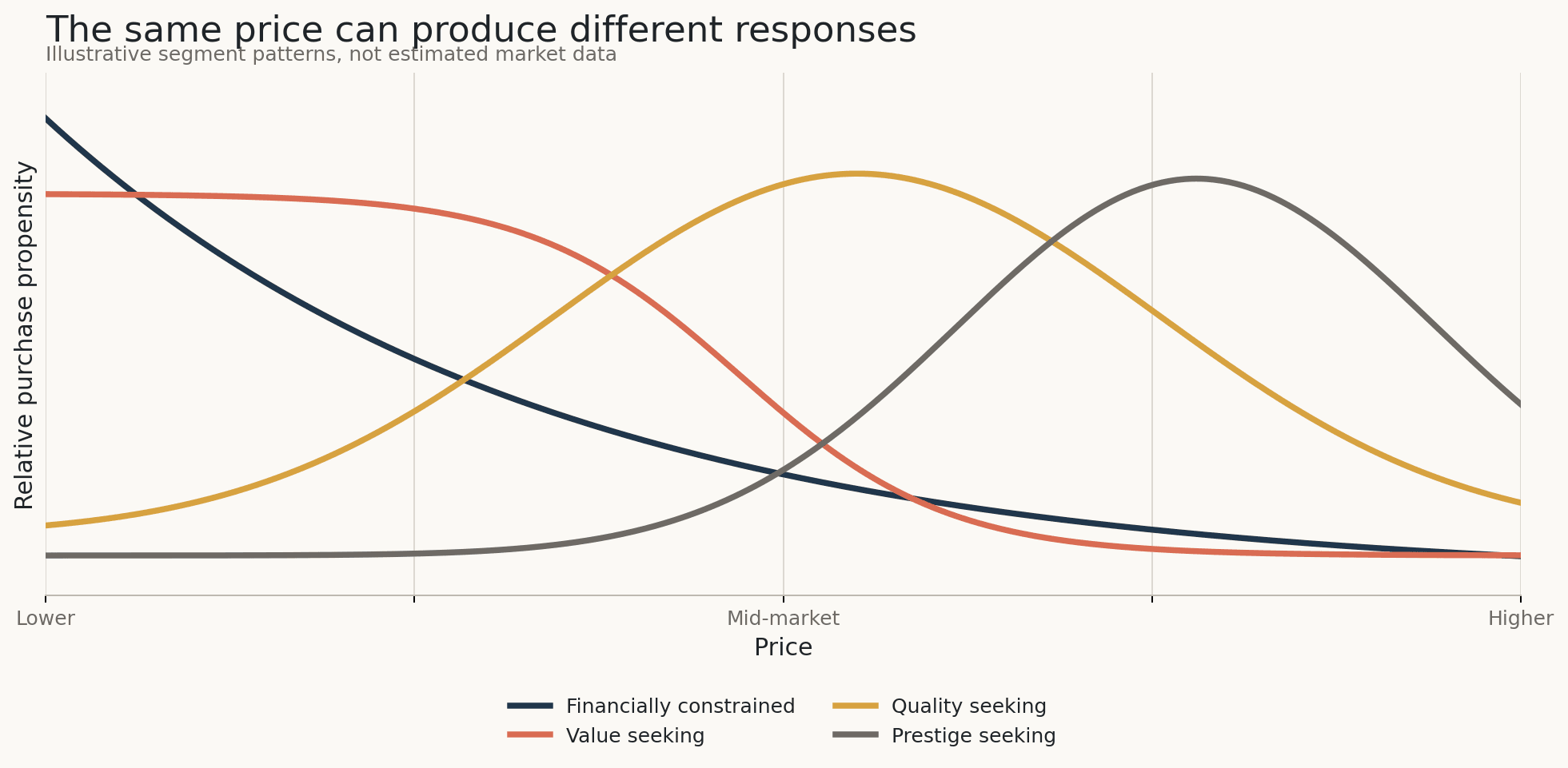
For some buyers, the effect is straightforward. They wanted the product, couldn’t justify the price and can now afford it. Others could have paid the full amount but enjoy knowing they got a deal. Both might buy during the same sale, for quite different reasons. Understanding your customer segments helps you tell those reasons apart.
Then there is the buyer who becomes suspicious when something looks too cheap. If two services appear similar, a higher price can suggest that one will do a better job. Rao and Monroe found a positive relationship between price and perceived quality in their review of earlier studies, although the effect varied with the other information buyers had available.1
The wine experiment is a memorable example. Participants tasted the same wine under different stated prices. They reported enjoying it more when they believed it cost more; the researchers also observed greater activity in a brain region associated with pleasantness.2 Expectations helped shape the experience.
Now consider a firm choosing someone to run its payroll. A very low quote might be welcome. It might also prompt a nervous question about what has been left out. If the buyer is worried about mistakes, a further discount may do little to reassure them.
This is why I would be cautious about calling a campaign successful just because it brought in cheaper customers. If your business depends on people staying for several years, you need to know whether the new arrivals have a reason to stay once the price goes back up.
There is a second question here: how many of those customers can you reach? A campaign can work well among a small group of enthusiastic bargain hunters, then become much more expensive as you try to expand it. Whether a segment can support growth matters as much as its response to the first campaign.
Before increasing the budget, look at who responded and how that group compares with your existing customers. Your previous campaigns may show whether similar buyers returned at full price. They may also show how acquisition cost changed as spending rose. If you haven’t got that evidence yet, keep the promotion small enough to learn from before committing to a larger rollout.
Price is interpreted socially
We also buy with other people in mind. An expensive coat might feel like a sensible investment to one household and an extravagance to another. The price is the same; the story people tell themselves about paying it is different.
Luxury adds another complication. Part of the appeal can come from owning something that few others have. Research by Han, Nunes and Drèze shows how preferences for visible branding vary with wealth and the desire to signal status.3 That doesn’t mean putting the price up will reliably increase sales. It does mean accessibility is not always an unqualified benefit to the buyer.
Business buyers have their own social pressures. The person approving the budget may like the cheaper quote. The person responsible for the rollout may be thinking about what happens if it goes wrong and they have to explain the decision to their boss.
Imagine that second person looking at a new software platform. They can afford the subscription. What worries them is moving their data and persuading colleagues to use it. Taking 20% off leaves both problems unresolved. Showing them how the migration works, with help included, gives them something more useful to consider.
That is a worthwhile message to test against the discount. Follow the buyers through setup and into actual use. If they never get started, a cheap sign-up has not solved much.
Why discounts cut through social advertising
Think about what someone is doing when your advert appears in their feed. They’re catching up with friends or watching a video. They probably haven’t opened the app to compare your product with its competitors. Your advert has to give them a reason to stop.
A discount can do that with very little explanation. “Better quality” asks the viewer to believe a claim. “Was £100, now £70” gives them a comparison they can grasp immediately, even if they know very little about the brand.
Of course, £70 may still be poor value. But the original price gives the viewer a convenient starting point. They can see a saving before they have worked out whether they want the product.
A deadline adds a reason to look now. There is a difference between “£70” and “£70 until Sunday”: one is a price, the other suggests an opportunity that could disappear. That depends on the deadline being credible. An offer that resets every Monday teaches a different lesson.
Research on scarcity helps explain part of this response. Shah, Mullainathan and Shafir found that having too little of a resource can focus attention on the immediate problem while other considerations receive less attention.4 Separate research found that scarcity messages can increase purchase intention, with different effects for limited-time and limited-quantity offers.5 These findings offer plausible explanations for why an offer attracts attention; they do not establish that discounts will outperform other creative in every social campaign.
Even the wording of the saving can matter. González and colleagues found that, for higher-priced products in their experiments, stating the cash saving produced higher perceived value and purchase intention than stating the equivalent percentage.6 So “£200 off” and “10% off” a £2,000 product need not produce the same response.
If your discount advert wins, take a closer look before concluding that your audience only cares about price. Perhaps the saving was simply easier to understand than your usual message. Try making the product’s value equally obvious. For the software buyer worried about migration, that could be a short demonstration of the transfer process. Then compare purchases and subsequent use, as well as clicks.
The acquisition algorithm learns from the offer
The offer may also influence who sees the next advert. When delivery is optimised for a particular action, the platform uses response data to help predict where that action is likely to happen again.
Suppose the promotion attracts a disproportionate number of people who respond to discounts. Their activity may help steer delivery towards more of the same opportunities. That is a possible consequence to investigate in your campaigns, rather than a rule that applies to every platform or audience.
It makes the choice of objective worth examining. A click tells you very little about whether someone will become a profitable customer. A purchase tells you more, but still says nothing certain about whether they will return. This is also why more leads can hide weaker performance: volume is only useful if enough of it turns into profitable business.
Ask whoever manages your advertising what the campaign is actually learning from. Where the platform supports it, useful purchase values or qualified conversion data can bring that signal closer to the result you care about. But the signal needs enough volume and must arrive soon enough to be useful. An annual renewal is valuable evidence for your own analysis; it may come far too late to guide a new campaign. No choice of event guarantees loyal customers.
How to measure whether a discount was worth it
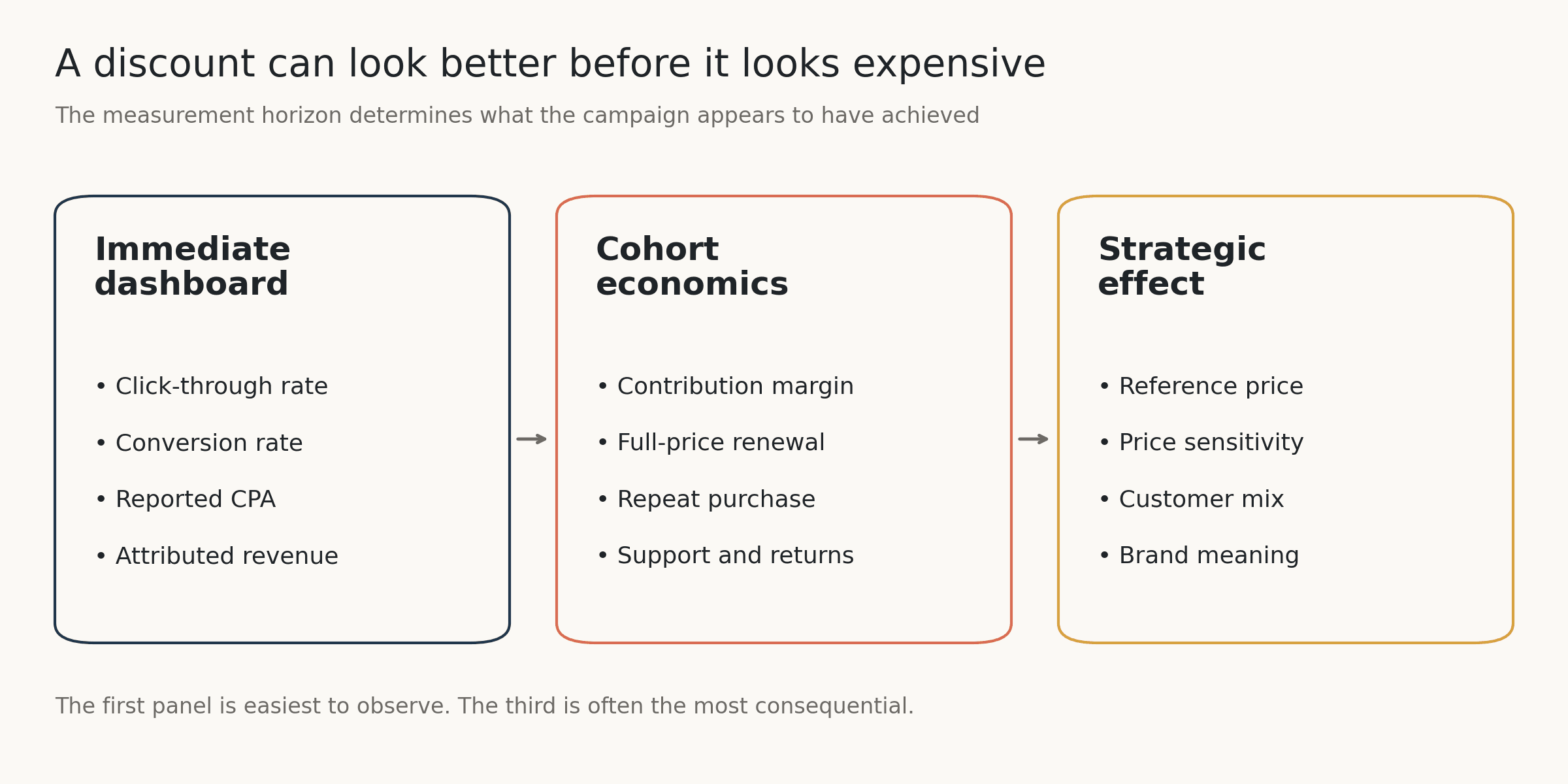
The discount has an immediate cost that a media dashboard can make surprisingly easy to overlook. Imagine a £100 sale with £60 in variable costs. That leaves £40 before advertising. Take £20 off the selling price and the amount left falls to £20. If advertising cost per customer drops from £15 to £10, your reported acquisition cost has improved, but the amount left after those costs has fallen from £25 to £10. These are illustrative figures, but the arithmetic is worth doing for your own offer.
Later effects take more patience to observe. Customers may start treating the promotional price as the normal one, or learn to wait for the next sale. Mela, Gupta and Lehmann studied more than eight years of consumer panel data and found that increased promotion was associated with greater price and promotion sensitivity.7
None of that makes discounts a bad idea by default. An introductory offer can give someone the confidence to try a product they go on to buy for years. The question is whether that happens often enough to pay for the discount, including the saving given to people who would have bought anyway.
Choose the review period around the purchase you are studying. For a monthly subscription, look at what happens when the introductory rate ends. For an annual contract, a 90-day report cannot answer the renewal question. Compare groups of customers acquired at similar times, often called cohorts, and give each group the same amount of follow-up. That gives you a fairer view of customer retention. If you want to establish what the promotion caused, a randomised test or suitable holdout is stronger evidence than comparing two campaigns that reached different audiences.
What Skype vs Zoom suggest about price
Skype once made an extraordinary offer: speak to someone on the other side of the world without paying international call rates. By 2005 it offered free calls between users and low-cost calls to ordinary telephone networks.8 The saving was easy to understand.
Zoom arrived later with an emphasis on making video meetings easier. Its 2019 flotation document described a service built around reliable video and ease of use.9 It also offered a free tier, so this was never a simple contest between a cheap service and an expensive one.
Microsoft retired Skype in May 2025.10 There were several reasons for its decline, including product decisions and Microsoft’s priorities; Zoom was one of several competitors.11 Still, the comparison raises a useful question. Once a call is already cheap or free, what makes someone choose one service over another? Being able to join a meeting without a struggle becomes rather important.
For a marketer, that is a reason to keep asking what the customer finds difficult after price has stopped being the main obstacle. A competitor that solves that problem may have a stronger proposition than another small saving.
When competing on price can work
There are good reasons to build a business around low prices. If you can deliver the same useful outcome at a lower cost than competitors, you may be able to charge less and still make a satisfactory margin.
The harder position is charging less because you are prepared to earn less, with no clear reason for that to change. Before you call it a market-share strategy, work out what scale is expected to improve and why a competitor cannot follow. A large customer base is only an advantage if the economics of serving it eventually work.
What to do before you discount
For your next campaign, write down what you expect the discount to achieve before looking at the results. Keep the test focused:
-
Identify the buyer you want to reach and the reason you think price is stopping them.
-
Test the discount against a message that addresses another specific hesitation. Give both versions a fair chance to work.
-
Agree what would justify scaling the campaign. Include the discount in the economics, rather than judging the offer on advertising cost alone.
-
Keep a record of which offer brought each customer in. Review what they spent, what they cost to serve and whether they returned after the promotion ended.
You may find that the discount works exactly as intended. Keep it if it does. But if the campaign only looks good until you account for the margin or wait for renewal, you have learnt something useful before spending more. The offer has helped choose your customers. Now you can judge whether they are the customers you meant to acquire.
Research and sources
2. Plassmann et al Marketing Actions Can Modulate Neural Representations of Experienced Pleasantness
3. Han Nunes and Dreze Signaling Status with Luxury Goods
4. Shah Mullainathan and Shafir Some Consequences of Having Too Little
5. Aggarwal Jun and Huh Scarcity Messages
6. Gonzalez Esteva Roggeveen and Grewal Amount Off Versus Percentage Off
7. Mela Gupta and Lehmann The Long Term Impact of Promotion and Advertising on Consumer Brand Choice
8. eBay Announcement of the acquisition of Skype 2005
9. Zoom Video Communications Form S 1 2019